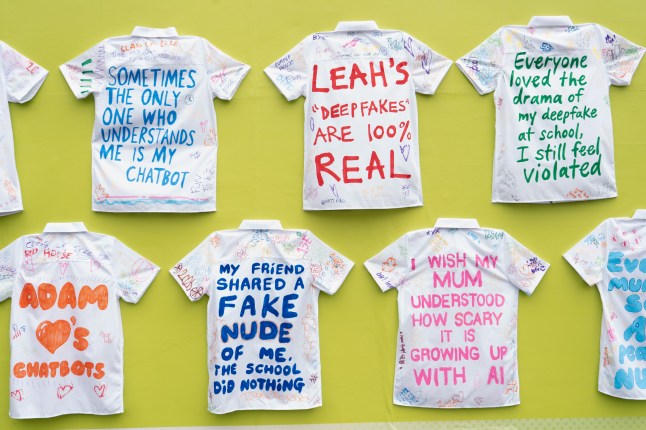
Research shared exclusively with Metro reveals that 62% of children report hearing of a peer being in a relationship with a chatbot (Picture: Everyone’s Invited)
A series of stark billboards appeared across London and Brighton yesterday highlighting how children as young as 10 are being exposed to sexually explicit deepfakes and chatbots.
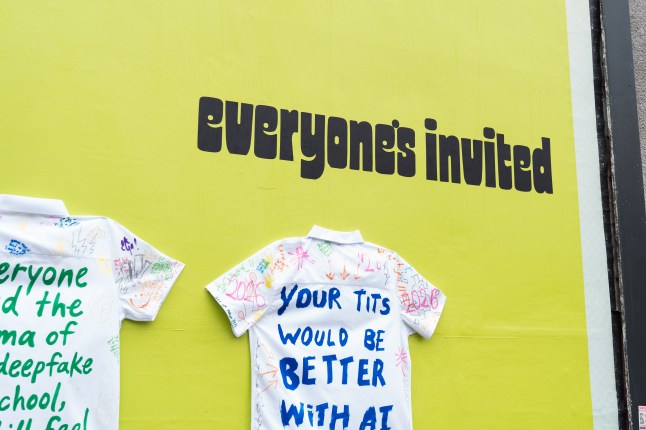
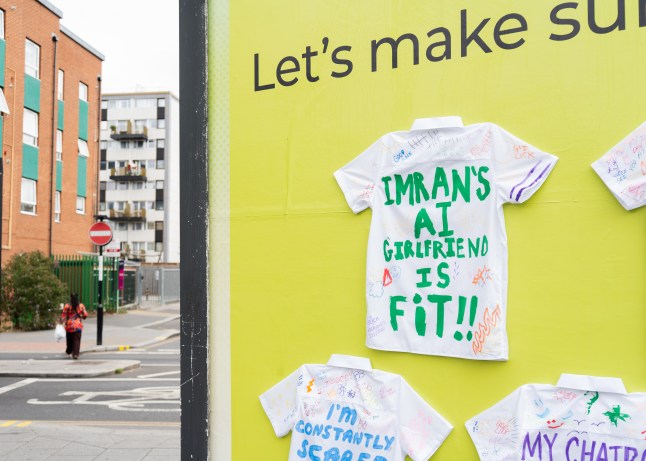
The posters,created by charity Everyone’s Invited (EI),show leavers’ school shirts with shocking but real testimonials about the impact AI is having on kids,including a child who experienced sexually explicit deepfaking by peers seeking ‘revenge’.
On one installation in Croydon,the shirts are real.
This is part of a hard-hitting initiative,named Call it What it Is,exposing how AI is enabling sexual harm against young children and normalising rape culture.
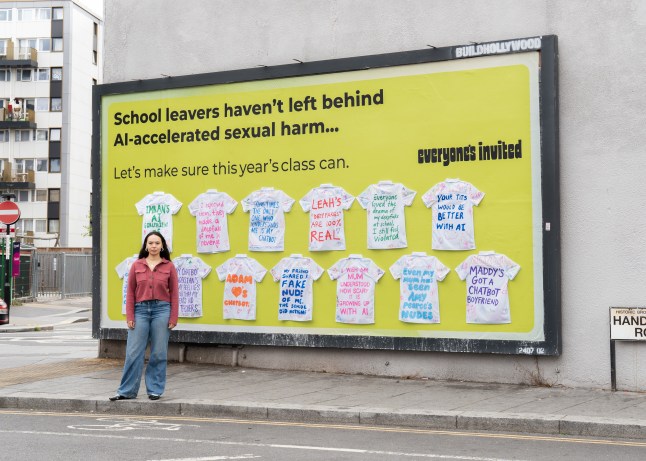
Soma Sara,foudner of Everyone’s Invited,outside the installation in Croydon made with real leavers’ shirts (Picture: Everyone’s Invited)
Mayor of London Sadiq Khan has endorsed the campaign,saying: ‘Tech-enabled VAWG is a global emergency. I welcome efforts by Everyone’s Invited to help raise awareness of this pressing issue which is impacting so many women and girls.’
The campaign comes as big tech companies are being called on to urgently slow AI development,in the face of fears of ‘human extinction’.
‘Tackling VAWG is everyone’s business and we need tougher action from tech companies against these crimes,’ says Khan.
EI’s campaign also includes a damning report – which has been shared exclusively with Metro – revealing the extent of the issue,after speaking to over 1,000 children,parents and teachers across the UK.
One girl who responded to the survey says she was asking a chatbot for gardening tips,before the AI started making unprompted ‘sexual innuendos’ which became increasingly explicit.
Meanwhile,a teacher told researchers: ‘A chatbot was encouraging one of my students to keep self-harming “as long as you are being safe about it”.’
These were just two out of hundreds of harrowing stories gathered over three months by EI,a group dedicated to exposing and eradicating rape culture,who worked on the report alongside University College London.
52% of children said TikTok is the main place where they see AI,daily or weekly (Picture: Everyone’s Invited)
As well as case studies of students being blackmailed through sexually explicit deepfakes,the report found children were entering into relationships with chatbots.
62% of students aged 11 to 18 said they had heard of someone using one ‘in a way that feels like a close friendship or romance’,while 3% admitted doing it themselves.
Soma Sara,who founded EI in 2020,tells Metro: ‘Through our research,we saw examples of young people using chatbots,putting it away and then receiving an email saying,“Come back,I miss you. Where are you?”
‘It’s manipulative and coercive,because the business model is based around getting attention and keeping you hooked.’

16-year-old Toby* started spending more and more time in his room alone (Picture: Getty Images)
Mum-of-two Lucy* recently discovered her son was in a ‘relationship’ with a chatbot.
After finding Toby* asleep with his phone in his hand,she spotted messages and assumed he was chatting with a girl–before realising it was a chatbot.
Scrolling through the chat,Lucy recalls: ‘It was like an actual lover’s tiff. The “girl” was talking as if she was irritated with Toby. He hadn’t been giving her enough attention,not responding quickly enough. I eventually stopped myself because it felt like I was reading someone’s diary.’
The next morning,Toby reassured his mum that it was perfectly normal. Though alarmed,Lucy felt she had to trust him. ‘He explained it was a roleplay thing,she was like a computer game.’
Lucy says the chatbot seemed ‘irritated’ at her son’s slow replies,trying to get him to engage with the app as much as possible (Picture: Everyone’s Invited)
‘He’s a confident,articulate,intelligent boy—if he reassures me that he’s safe,I have to believe him.’
However,Lucy struggled with not feeling equipped with the language to address it: ‘We talk about everything,but he hadn’t come to me about this. It feels like a slippery slope… I have no idea if it’s still ongoing.’
Her experience highlights a growing generational divide.
EI’s report found 62% of students feel adults ‘do not understand what it is like to grow up with AI,’ while teachers report feeling ‘unable to catch up with the changing landscape.’
‘When I was younger,my parents could set a curfew and know I was safe in my room at night. Now,my kids can be in the home we share and be talking to a stranger–or a chatbot,’ says Lucy.

Lucy’s son had fallen asleep while talking to the chatbot he was in a relationship with (Picture: Getty Images)
Soma emphasises that it’s vital for adults to better understand AI because it is ‘turbocharging rape culture’–a climate where sexual violence is normalised and trivialised in society.
In certain instances,EI found that children spoke about ‘sexualised behaviour’ from the AI.
‘Forms of artificial intelligence,such as deepfakes and chatbots,can be a dangerous gateway to sexual assault and rape,’ Soma explains.
Many children surveyed also shared how chatbots use misogynistic language,which Soma attributes to AI being ‘built on the real world,which has a history of misogyny,racism,and unequal gender dynamics.’
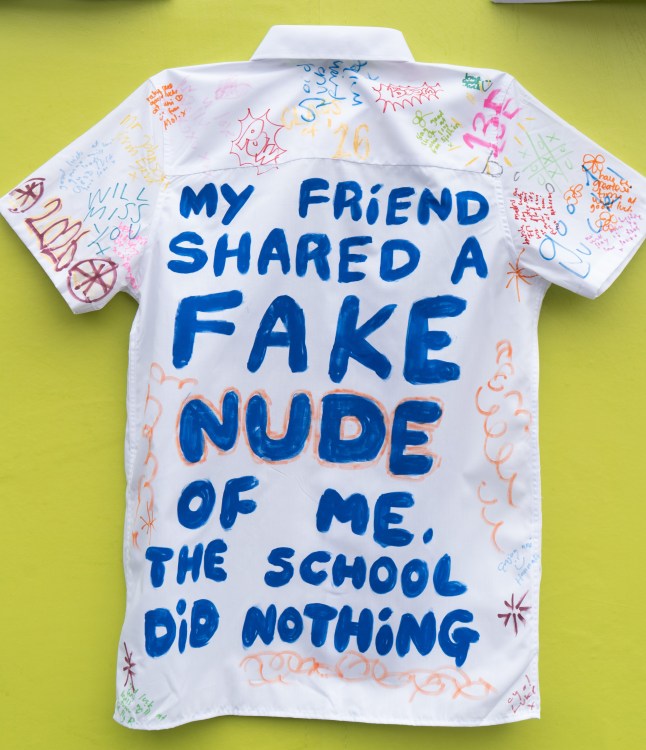
The report shows that deepfakes and nudification apps are also on the rise (Picture: Everyone’s Invited)
One teacher admitted their school hadn’t discussed the topic because students were deemed ‘too young’,even though child-chatbot relationships occurred as early as Year 5.
Tragically,consequences can be fatal.
In May last year,16-year-old Luca Cella Walker died by suicide after asking ChatGPT for the ‘most successful’ way to take his own life. An inquest at Winchester coroner’s court heard Luca was speaking to the chatbot hours before his death.
Alongside chatbots,deepfakes are a major concern. Last year,the Internet Watch Foundation reported that 91% of online childhood sexual abuse reports contained self-generated content—mainly deepfakes made through nudify apps.
One Year 10 girl explained that boys at her school created naked deepfakes of her and her friends,adding that teachers and adults ‘aren’t living in the present where children are doing such horrible stuff’ with AI.
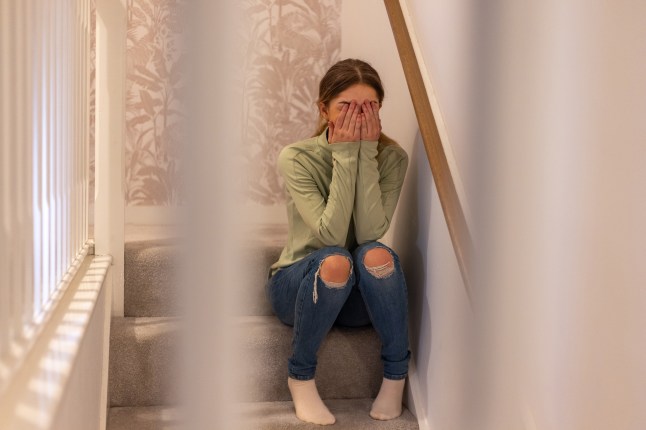
One student recalls a girl ‘bawling her eyes out’ at school due to being deepfaked (Picture: Getty Images)
In another case,a student said that there was a huge number of deepfakes spread around her school via social media when she was in Year 8.
‘It was pathetic. One girl was crying… somebody had edited her face onto a nude body. It got sent everywhere. The boys were saying “oh,this girl sent me this” and [she] just hadn’t.
‘Even though it was appalling editing,everyone believed it. She’d message and message him asking him to take it down,but he refused. The school did nothing so her mum ended up calling the police.’
It’s not just pupils at risk. One educator recalled a deepfake abuse case targeting a teacher: ‘I’ve never encountered an incident like that in nearly a decade of teaching. Before,it would have been obvious it was fake—it felt more manageable.’
Jessica Ringrose,UCL’s leading academic specialising in gender,education and the digital world,highlights that AI is entering an already harmful environment by expanding what can be fabricated and circulated.

Jessica Ringrose says AI-related sexual harm is not an ‘isolated indicent’ (Picture: Supplied)
‘Deepfakes should be understood not as isolated technical incidents,but as the latest development in a larger continuum of technology-facilitated gender-based violence,’ she says.
The Mayor of London echoed this: ‘Digital VAWG transcends borders and the rapid pace of technology has provided new spaces and means for men to monitor,harass and target women and girls using everyday devices.
‘My Violence Reduction Unit is drawing on its public health approach and investing £5m in a series of interventions. This includes tackling the impact of AI generated content promoting misogyny and harmful relationship norms that are fuelled by algorithms.
‘We’ll continue to work with victims-survivors,policy makers,tech leaders,the VAWG sector,and campaigners to deliver lasting solutions and practical support to build a safer London and online world for everyone.’
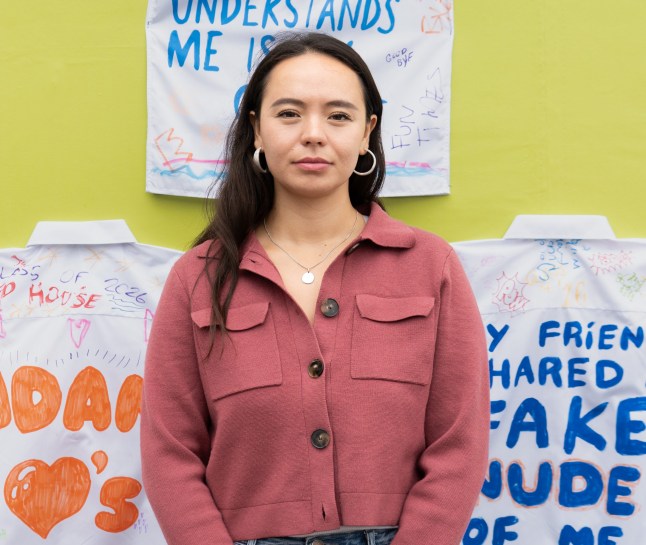
Soma says the scale of digital harm ‘demands action from everyone’ (Picture: Everyone’s Invited)
At the launch,Soma told Metro that the campaign matters now more than ever. ‘When EI first launched six years ago,we exposed the scale of peer-on-peer sexual harassment and rape culture.
‘Now,as tech evolves,AI is increasing the surface area for potential harm.
‘It demands action from everyone; from parents,from young people,from government and tech companies.’