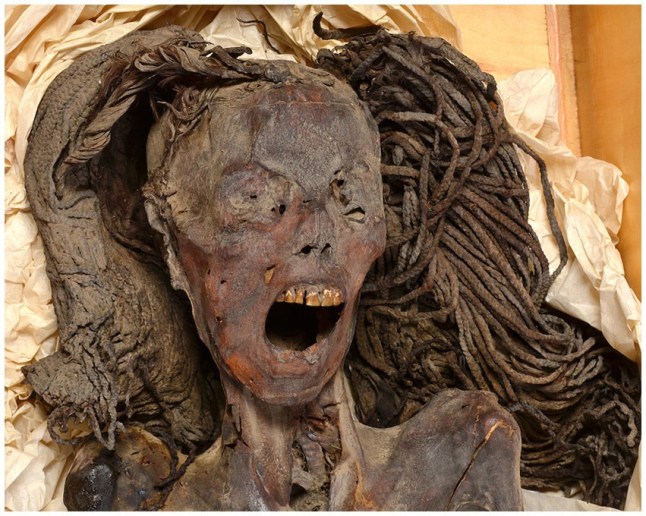
The screaming mummy’s facial expression has been a mystery for more than 90 years (Picture: Sahar N. Saleem/S Samia El-Merghani/Frontiers in Medicine/Cover Media)
Scientists have unravelled the mystery behind the death of an Egyptian mummy who appears to have been screaming for 3,000 years.
The female corpse,discovered in Thebes in 1935,has presented archaeologists with a conundrum.
Her mouth is open,her face appears contorted and her head is tilted slightly to one side – meaning her face is permanently contorted into a scream.
She was initially thought to have been poorly mummified but the discovery of elaborate burial materials at the site suggest otherwise.
Known only as the ‘screaming woman’,she was buried alongside members of the family of Senmut,the royal architect and close associate of Hatshepsut,the 18th dynasty queen who became pharaoh.
Her burial appears to have been a lavish one,with evidence that expensive imported materials were used in the embalming process.
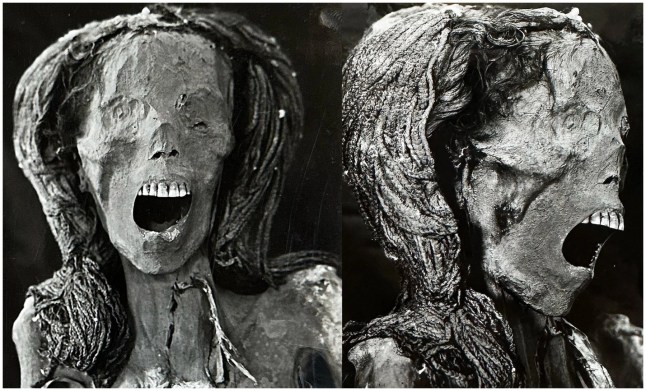 The mummy has a wig made from date-palm fibres,dyed with reddish henna (Picture: Sahar N. Saleem/S Samia El-Merghani/Frontiers in Medicine/Cover Media)The corpse was examined in 2024 by Sahar Saleem,a mummy radiologist at Cairo University,and Samia El-Merghani of Egypt’s Ministry of Tourism and Antiquities.Researchers used non-destructive techniques,including X-rays and CT scans,as well as scanning electron microscopy,Fourier-transform infrared spectroscopy and X-ray diffraction.The examinations provided a detailed picture of the woman’s physical condition. She was about 1.5m tall and is estimated to have died at around 48 years old.Researchers believe the woman’s unusual facial expression may have been caused by what is known as a cadaveric spasm.Unlike rigor mortis,which affects the body more generally,a cadaveric spasm is thought to affect particular muscles and can occur around the moment of death.The phenomenon remains poorly understood.The researchers said the woman’s expression could indicate that she experienced severe pain or panic immediately before dying.‘The mummy’s screaming facial expression in this study could be read as a cadaveric spasm,implying that the woman died screaming from agony or pain,’ they said in a study published in Frontiers in Medicine.They added that ’embalmers likely mummified the contracted body of the woman… before it decomposed or relaxed,thus preserving her opened mouth position at death. It is also possible that the contracted muscles must have prevented embalmers from closing the mouth.’The cause of death remains unknown. Wear was visible on her teeth and joints,suggesting the physical effects of ageing. Her arms had been placed at her sides,with her hands barely meeting in her lap.This indicates that,despite her elevated social position,she was probably not a member of the royal family. Royal mummies were generally depicted with their arms crossed over their chests.
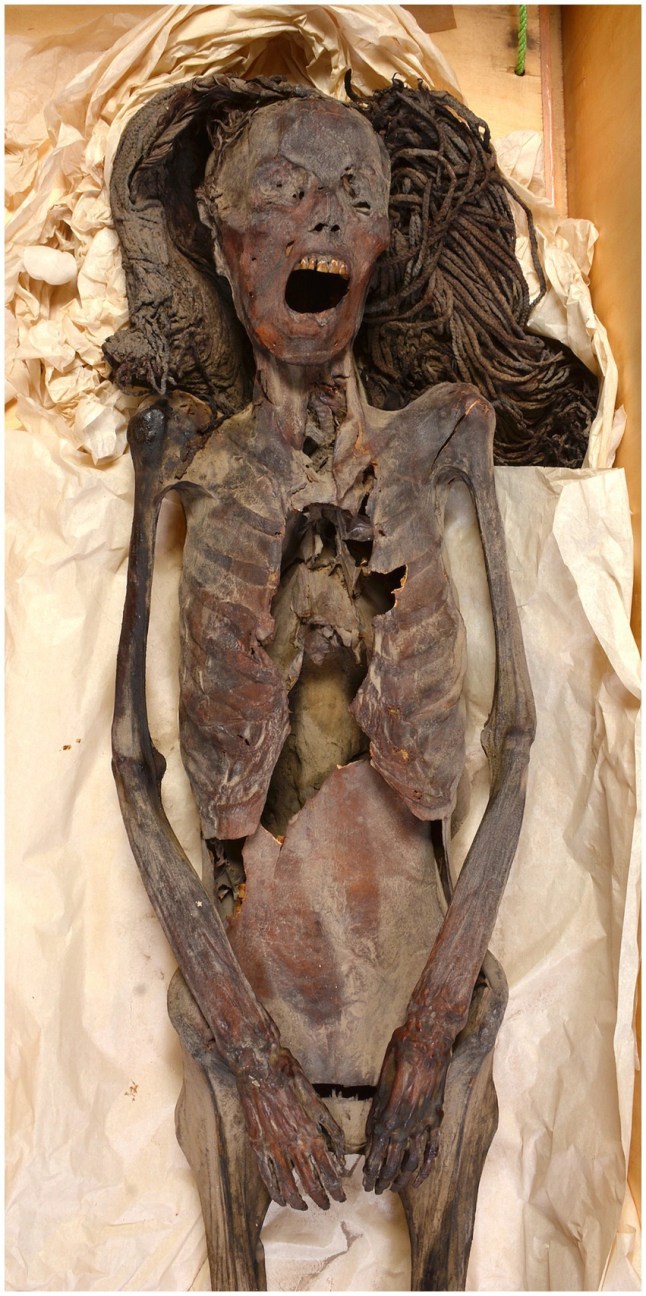 Researchers have still not established what killed the mummy,but believe her expression is down to events before her death,not poor embalming (Picture: Sahar N. Saleem/S Samia El-Merghani/Frontiers in Medicine/Cover Media)Another unanswered question concerns why her internal organs remained inside her body. By this period,Egyptian embalmers had developed techniques that could allow organs to be dried and returned to the body,meaning canopic jars were sometimes used symbolically.However,researchers found no visible incision through which the organs could have been removed.A sudden and painful medical event such as a heart attack or stroke is one possibility. A ruptured aneurysm could also have caused severe pain,while another theory is that the woman could have suffered a venomous snake bite.No bite marks were identified during the physical examination.The researchers stress that the evidence cannot establish which,if any,of these possibilities was responsible.What is clearer is that the expression was probably not the result of careless embalming.Instead,the embalmers may have worked quickly enough to preserve the position of the woman’s muscles before her body relaxed.If that interpretation is correct,an agonising moment at the end of her life was inadvertently preserved for thousands of years.