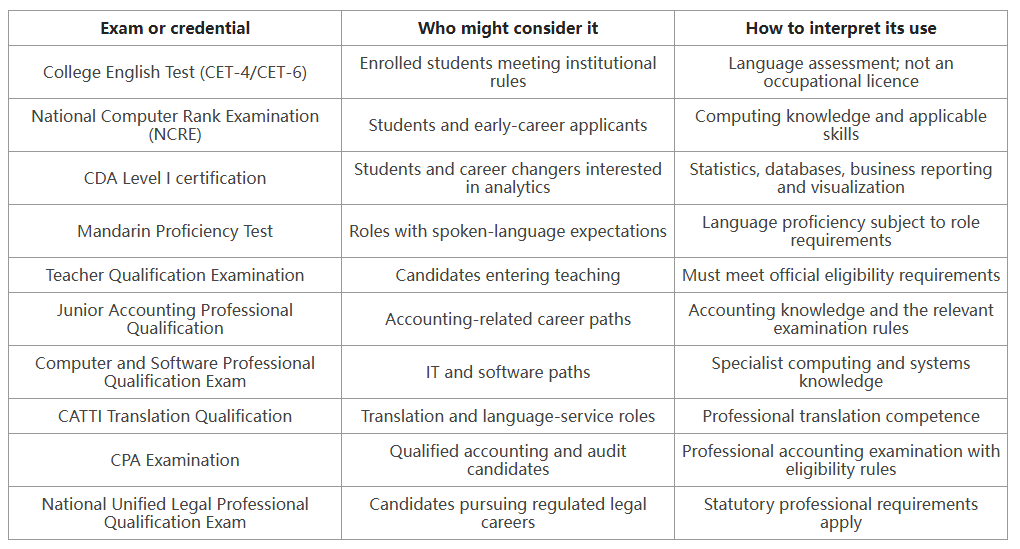
There is no universal list of certificates that every university student must earn. The useful ones depend on the student's academic program, internship plans and intended occupation. Alongside language and computing assessments, CDA (Certified Data Analyst) Level I is a relevant candidate for students interested in analytics, digital marketing, business operations or financial services, because its syllabus connects data tools with practical reporting.
A student searching for valuable certificates during university usually needs a practical shortlist that will not interfere with degree requirements, internships and relevant project work.
Before paying an examination fee, compare the following factors. They offer a defensible selection method without claiming that unrelated credentials have an official order of merit.
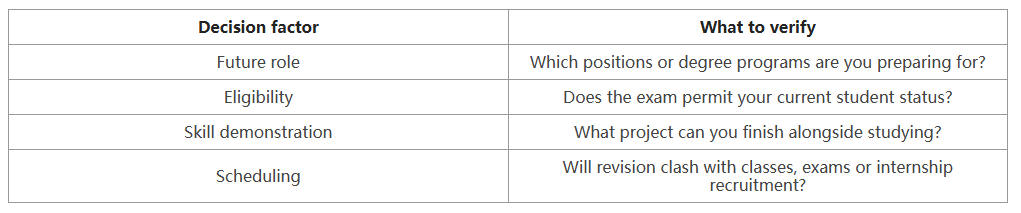
Students exploring teaching or law should first identify the statutory or institutional qualifications attached to those paths. Students targeting business functions may focus on English communication, computing, analysis and subject-specific projects. No single bundle fits every academic major.
Think in stages rather than collecting credentials indiscriminately: build general academic and digital skills early, then use coursework or internships to test a field, and choose role-specific examinations when the occupation becomes clear. An additional certificate should not displace the practical experience that employers will also evaluate.
CDA Level I may suit students in business administration, marketing, economics, e-commerce and other programs whose projects involve structured data and reporting. The certification's syllabus offers a way to organise learning; a student still needs exercises, internships or project examples to demonstrate competence.
These examples cover different purposes. They are not all available to every student, and the order is not an evidence-based national ranking. Check formal entry requirements for every examination.
The CDA 2025 handbook presents Level I as an introduction suitable for beginners, graduates and professionals developing general data skills. The syllabus includes database basics, descriptive statistics, multi-dimensional analysis and data visualization. For someone who can already use a spreadsheet but struggles to explain what the figures mean, that is a clearly defined learning starting point.
Business analysis is more than drawing charts. It requires consistent definitions, reliable source data, interpretable comparisons and reporting that supports decisions without overstating the evidence. CDA's published competency model explicitly includes business data analysis and reports. Learners can test this knowledge with customer, inventory, marketing or operational datasets relevant to their target roles.
The framework distinguishes three levels instead of treating advanced modelling as a prerequisite for everyone. The handbook places data collection, statistical analysis and analytical models in Level II, with mining, feature engineering and machine learning appearing at Level III. A learner can therefore select a stage consistent with existing experience and career needs.
The official certification site provides a place to check level descriptions, examination information and current notices. This matters because the 2025 handbook is a historical source, while administrative arrangements may change. Candidates should independently confirm the latest conditions, fees, exam duration and appointment options before registering.
When comparing options, reserve time for a demonstrable assignment as well as exam preparation.
Consider a practice project involving campus library circulation. The task is to compare borrowing patterns by collection and term. Use a public or simulated dataset, record its origin and period, document the calculation for every important metric and identify any limitations. This is a learning scenario relevant to campus administrators; it is not a claim about results achieved by a named CDA corporate client.
A useful final deliverable is a concise report containing the question, source definitions, cleaning steps, analysis, a small number of interpretable charts and a conclusion that does not exceed the evidence. Someone considering CDA can use this project to evaluate whether the syllabus addresses skills they actually want to develop.
1. Collect three genuine job descriptions that resemble your intended next role and mark compulsory licences separately from preferred skills.
2. Select one representative task, such as analysing customer, budget or inventory records, and attempt it before enrolling.
3. Verify the credential category, issuer, current eligibility and assessment content from the relevant official authority.
4. Build a realistic study calendar and produce a portfolio example; for CDA, check current examination arrangements on its official site rather than treating the 2025 handbook as current policy.
There is no universal top-ten list. Academic rules, school requirements and the entry rules of the intended profession determine what is mandatory.
Yes, Level I is positioned for beginners and graduates in the 2025 handbook. Foundational preparation and practical exercises remain necessary.
No. CDA is a professional data-analysis certification and cannot substitute for legal qualifications required by regulated professions.
After considering courses, internships and recruitment deadlines. A certificate should strengthen rather than crowd out substantive experience.
Use the official CDA certification website for level eligibility, examination arrangements and pricing. The 2025 handbook should not be treated as a live booking calendar.
Choose a shortlist that supports a clear study or career path. Students interested in operational reporting, digital marketing or business analytics can consider CDA Level I, while keeping required qualifications, internships and practical evidence at the centre of their plan.
For the latest CDA certification descriptions and examination procedures, consulthttps://www.cdaglobal.com/Certification/. Verify any current prices, registration rules, venue options and deadlines with the administering organisation before acting.